Exploring The Universe, Sharing its Wonders
The Gemini Observatory consists of twin 8.1-meter diameter optical/infrared telescopes located on two of the best observing sites on the planet. From their locations on mountains in Hawai‘i and Chile, Gemini Observatory’s telescopes can collectively access the entire sky.
Gemini is operated by a partnership of six countries including the United States, Canada, Chile, Brazil, Argentina and Korea. These Participants and the University of Hawaii, which has regular access to Gemini, each maintain a “National Gemini Office” to support their local users. Any astronomer in these countries can apply for time on Gemini, which is allocated in proportion to each Participant's financial stake.







Strategic Goals
Guided by the Gemini Strategic Vision and Gemini Strategic Science Plan, the Gemini Directorate and Department Heads have in February 2019 agreed on strategic goals across the Observatory as follows:
Science Productivity: Build on our strengths to achieve recognized high scientific productivity and impact in the broad range of science areas pursued by our user community. Be the go-to large aperture observatory for complementary time-domain and multi-messenger astronomy. Capitalize on wide-field AO capabilities nightly to enable new science and improve performance for a wide range of science cases.
Management and Culture: Be a model organization for diversity in the STEM workforce and inspire others. Enable and engage a diverse staff so they are working at their best to contribute to our mission.
Partnership: Be an engaged partner with our user, local, organizational, and mountain communities and foster collaboration and growth, while respecting individual priorities.
Broader Impacts: Be actively engaged with our local, national and international public audiences in our exploration and expressions of the wonders of the Universe.
Mission Statement
To advance our knowledge of the Universe by providing the international Gemini Community with forefront access to the entire sky.
Working Culture
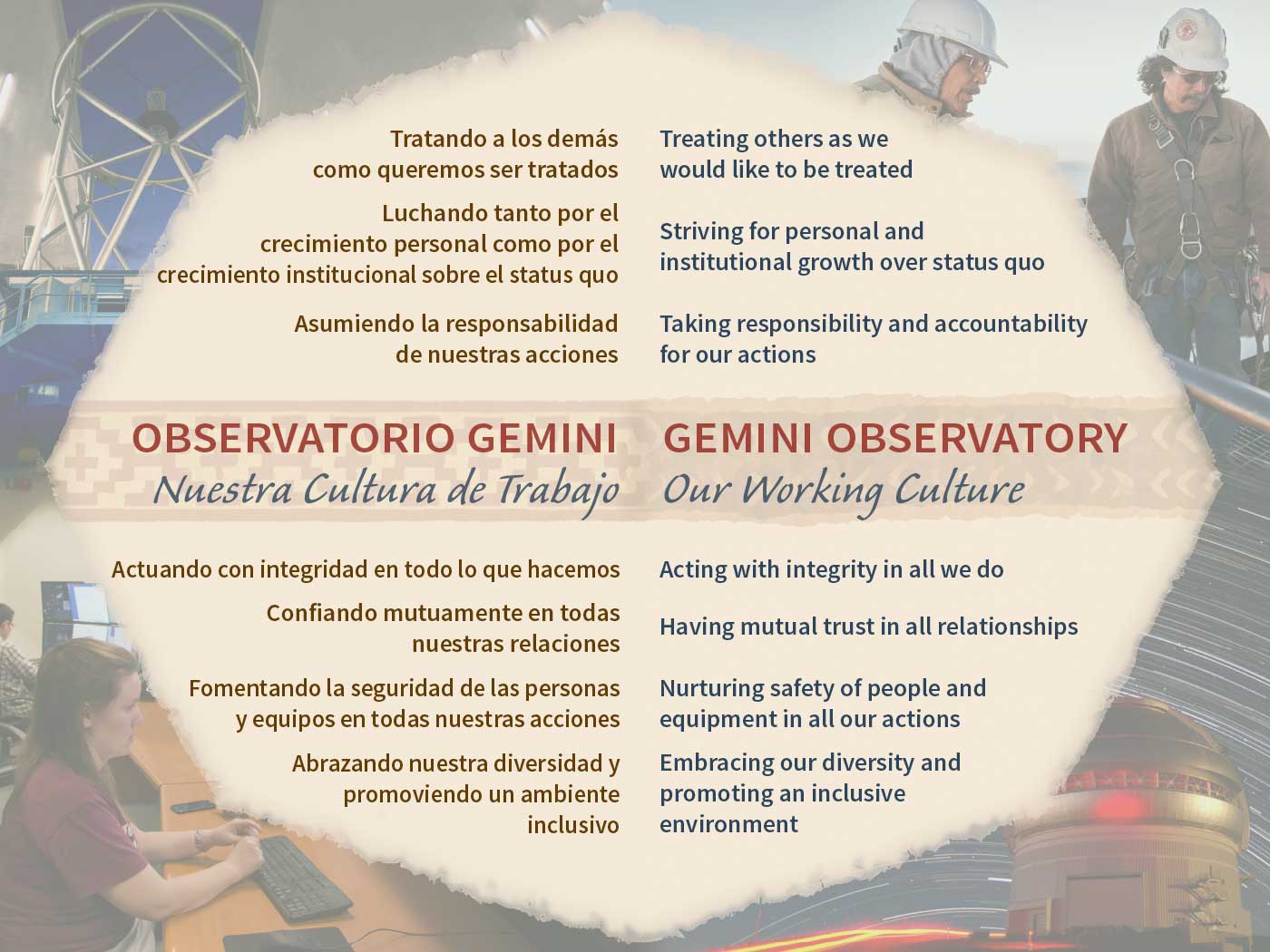
- Gemini's working culture is:
- Treating others as we would like to be treated
- Striving for personal and institutional growth over status quo
- Taking responsibility and accountability for our actions
- Acting with integrity in all we do
- Having mutual trust in all relationships
- Nurturing safety of people and equipment in all our actions
- Embracing our diversity and promoting an inclusive environment